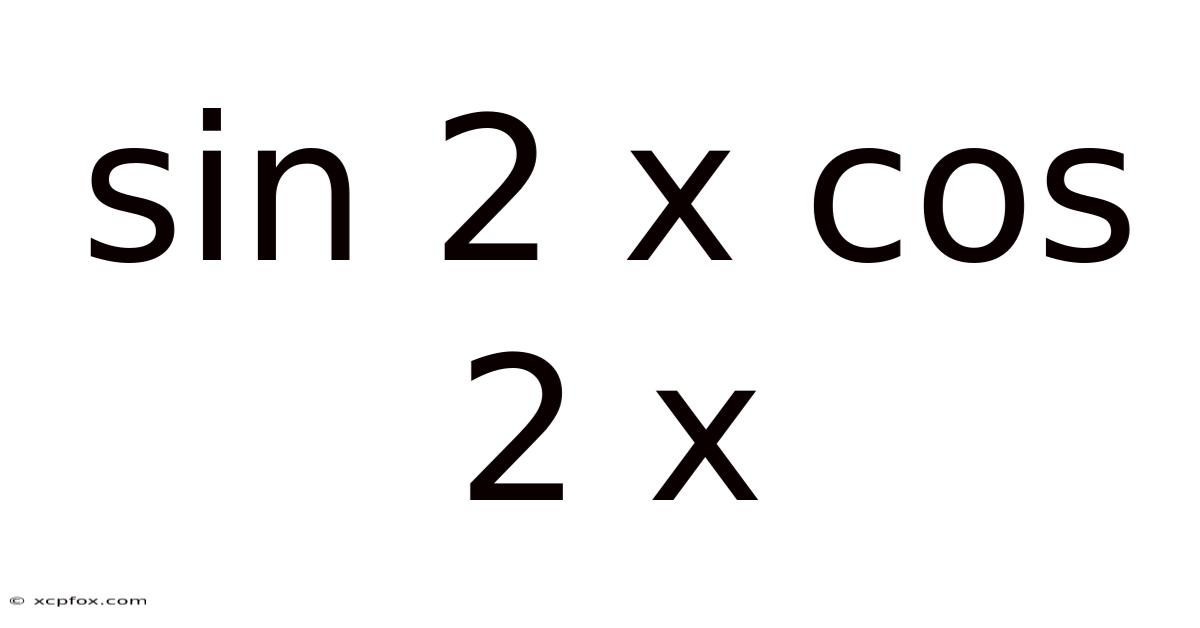
The world of trigonometry is full of fascinating identities and relationships that can sometimes seem like magic. In real terms, among these, expressions involving trigonometric functions like sine and cosine are particularly useful. Have you ever wondered how seemingly complex expressions can be simplified into something surprisingly elegant?
Think about those challenging math problems that initially appear daunting but, with the right approach, reveal a beautifully simple solution. Similarly, trigonometric expressions like sin 2x cos 2x can be transformed using various identities, offering not just simpler forms but also deeper insights into the relationships between angles and their trigonometric values.
Decoding sin 2x cos 2x: A Comprehensive Exploration
Trigonometry, at its core, is the study of relationships between angles and sides of triangles. Trigonometric functions like sine, cosine, and tangent are fundamental tools in this field, finding applications in various areas such as physics, engineering, and computer graphics. Among the myriad of trigonometric expressions, those involving multiples of angles, such as sin 2x and cos 2x, hold significant importance. The expression sin 2x cos 2x combines these two functions and can be simplified and understood through various trigonometric identities Simple, but easy to overlook..
The Essence of Trigonometric Identities
Trigonometric identities are equations that are true for all values of the variables involved. On top of that, they are essential for simplifying expressions, solving equations, and proving other results in trigonometry. These identities are derived from the basic definitions of trigonometric functions and the Pythagorean theorem Most people skip this — try not to..
- Pythagorean Identity: sin²x + cos²x = 1
- Double Angle Identities:
- sin 2x = 2 sin x cos x
- cos 2x = cos²x - sin²x
- Other Useful Identities:
- cos²x = (1 + cos 2x) / 2
- sin²x = (1 - cos 2x) / 2
These identities form the building blocks for manipulating and simplifying more complex trigonometric expressions.
Deep Dive into sin 2x
The double angle identity for sine, sin 2x = 2 sin x cos x, is a cornerstone in trigonometry. Which means it expresses the sine of twice an angle in terms of the sine and cosine of the angle itself. This identity can be derived geometrically using the angle addition formula for sine, which states that sin(A + B) = sin A cos B + cos A sin B.
sin(x + x) = sin x cos x + cos x sin x = 2 sin x cos x
Thus, sin 2x = 2 sin x cos x Worth knowing..
This identity is incredibly useful in simplifying expressions and solving equations involving multiples of angles. Here's one way to look at it: it allows us to rewrite expressions involving sin 2x in terms of sin x and cos x, which can often lead to further simplification or solution.
Exploring cos 2x
The double angle identity for cosine, cos 2x = cos²x - sin²x, is another fundamental identity in trigonometry. Unlike the sine double angle identity, the cosine double angle identity has two other common forms, which can be derived using the Pythagorean identity sin²x + cos²x = 1 Easy to understand, harder to ignore..
- Using sin²x + cos²x = 1 to express cos²x in terms of sin²x:
- cos²x = 1 - sin²x
- Substituting this into cos 2x = cos²x - sin²x, we get:
- cos 2x = (1 - sin²x) - sin²x = 1 - 2 sin²x
- Using sin²x + cos²x = 1 to express sin²x in terms of cos²x:
- sin²x = 1 - cos²x
- Substituting this into cos 2x = cos²x - sin²x, we get:
- cos 2x = cos²x - (1 - cos²x) = 2 cos²x - 1
Thus, we have three equivalent forms for cos 2x:
- cos 2x = cos²x - sin²x
- cos 2x = 1 - 2 sin²x
- cos 2x = 2 cos²x - 1
Each of these forms is useful in different contexts, depending on the specific problem or expression you are trying to simplify Nothing fancy..
Simplifying sin 2x cos 2x
Now, let's focus on the expression sin 2x cos 2x. That said, this expression combines the sine and cosine of twice an angle. To simplify it, we can use the double angle identity for sine, sin 2x = 2 sin x cos x.
The expression sin 2x cos 2x can be simplified by multiplying and dividing by 2:
sin 2x cos 2x = (1/2) * 2 * sin 2x cos 2x
Notice that 2 sin 2x cos 2x looks like the double angle identity for sine, but with 2x instead of x. So, we can rewrite it as sin(2 * 2x) = sin 4x.
So, sin 2x cos 2x = (1/2) sin 4x.
This simplified form is much easier to work with and provides a clear understanding of the relationship between the expression and the angle 4x Still holds up..
Visualizing Trigonometric Functions
Understanding trigonometric functions is greatly enhanced by visualizing them on the unit circle. The unit circle is a circle with a radius of 1 centered at the origin of the Cartesian coordinate system. For any angle x, the coordinates of the point where the terminal side of the angle intersects the unit circle are (cos x, sin x).
This is where a lot of people lose the thread.
- Sine Function: The sine function represents the y-coordinate of the point on the unit circle. As the angle x increases, the y-coordinate oscillates between -1 and 1, creating the familiar sine wave.
- Cosine Function: The cosine function represents the x-coordinate of the point on the unit circle. Similarly, as the angle x increases, the x-coordinate oscillates between -1 and 1, creating the cosine wave.
Visualizing sin 2x and cos 2x on the unit circle helps understand how the functions behave as x changes. The 2x in sin 2x and cos 2x means that the functions complete two full cycles as x goes from 0 to 2π, effectively compressing the wave.
Some disagree here. Fair enough Easy to understand, harder to ignore..
Trends and Latest Developments
In recent years, trigonometric functions and identities have seen renewed interest and application in various fields. Here are some notable trends and developments:
- Quantum Computing: Trigonometric functions play a crucial role in quantum mechanics, which is the foundation of quantum computing. Quantum algorithms often rely on precise manipulations of quantum states using trigonometric functions to achieve computational advantages.
- Signal Processing: Trigonometric functions are fundamental in signal processing, particularly in Fourier analysis. The ability to decompose signals into their constituent frequencies using sine and cosine functions is essential in many applications, including audio and image processing.
- Machine Learning: While not as direct as in other fields, trigonometric functions are used in machine learning for feature engineering and data transformation. Periodic data or data with cyclical patterns can be effectively modeled using trigonometric functions.
- Computer Graphics and Animation: Trigonometric functions are extensively used in computer graphics and animation to create realistic movements and transformations. Rotations, scaling, and other transformations are often implemented using trigonometric functions.
- Advanced Materials Science: The study of crystal structures and material properties often involves trigonometric analysis. The arrangement of atoms in a crystal lattice can be described using trigonometric functions, helping scientists understand and predict material behavior.
These trends highlight the ongoing relevance and importance of trigonometric functions in modern science and technology. As new applications emerge, a solid understanding of trigonometric identities and their properties will continue to be essential for researchers and practitioners.
Tips and Expert Advice
Mastering trigonometric expressions like sin 2x cos 2x requires a combination of understanding the underlying principles and practicing problem-solving. Here are some tips and expert advice to help you:
- Memorize Key Identities: The double angle identities, Pythagorean identity, and other fundamental identities are the tools you'll use most often. Make sure you know them by heart.
- Practice Regularly: The more you practice, the more comfortable you'll become with manipulating trigonometric expressions. Work through a variety of problems, starting with simple ones and gradually increasing in complexity.
- Understand the Unit Circle: Visualizing trigonometric functions on the unit circle can provide valuable insights into their behavior. Use the unit circle to understand how sine, cosine, and tangent change as the angle varies.
- Break Down Complex Expressions: When faced with a complex expression, try to break it down into simpler parts. Look for opportunities to apply trigonometric identities to simplify the expression step by step. Take this: with sin 2x cos 2x, recognizing sin 2x as 2 sin x cos x is the first step.
- Use Algebra Wisely: Trigonometric simplification often involves algebraic manipulation. Be comfortable with factoring, expanding, and simplifying algebraic expressions. To give you an idea, simplifying cos²x - sin²x might involve recognizing it as a difference of squares.
- Verify Your Results: After simplifying an expression or solving an equation, always verify your results. You can use a calculator or graphing software to check that your simplified expression is equivalent to the original one.
- Look for Patterns: As you work through more problems, you'll start to notice patterns and common techniques. These patterns can help you solve problems more quickly and efficiently. Take this: recognizing that multiplying sin x cos x by 2 often leads to a double angle identity is a useful pattern.
- Apply to Real-World Problems: Understanding how trigonometric functions are used in real-world applications can make the subject more engaging. Look for examples in physics, engineering, and computer graphics to see how these functions are used in practice.
- Use Technology: There are many online tools and software packages that can help you with trigonometric simplification. Use these tools to check your work and explore different approaches to solving problems.
- Consult Resources: Don't hesitate to consult textbooks, online resources, and experts when you're struggling with a problem. There are many excellent resources available to help you learn trigonometry.
FAQ
Q: What is the double angle identity for sine?
A: The double angle identity for sine is sin 2x = 2 sin x cos x.
Q: What are the double angle identities for cosine?
A: The double angle identities for cosine are: cos 2x = cos²x - sin²x cos 2x = 1 - 2 sin²x cos 2x = 2 cos²x - 1
Q: How can sin 2x cos 2x be simplified?
A: sin 2x cos 2x can be simplified to (1/2) sin 4x.
Q: Why are trigonometric identities important?
A: Trigonometric identities are important because they help us simplify complex expressions, solve equations, and prove other results in trigonometry. They are fundamental tools in various fields such as physics, engineering, and computer graphics.
Q: Where can I find more information about trigonometric identities?
A: You can find more information about trigonometric identities in textbooks, online resources, and educational websites. Khan Academy, Wolfram MathWorld, and various university websites offer comprehensive explanations and examples Simple, but easy to overlook..
Conclusion
Understanding and simplifying trigonometric expressions like sin 2x cos 2x is a fundamental skill in trigonometry with applications in various fields. By mastering key identities, practicing regularly, and visualizing functions on the unit circle, you can gain a deeper understanding of these concepts. The simplified form of sin 2x cos 2x, which is (1/2) sin 4x, showcases the elegance and utility of trigonometric identities Most people skip this — try not to..
Ready to put your knowledge to the test? Try simplifying other trigonometric expressions and explore how these identities are used in real-world applications. And share your findings and questions in the comments below! Let's continue the discussion and deepen our understanding of trigonometry together.
