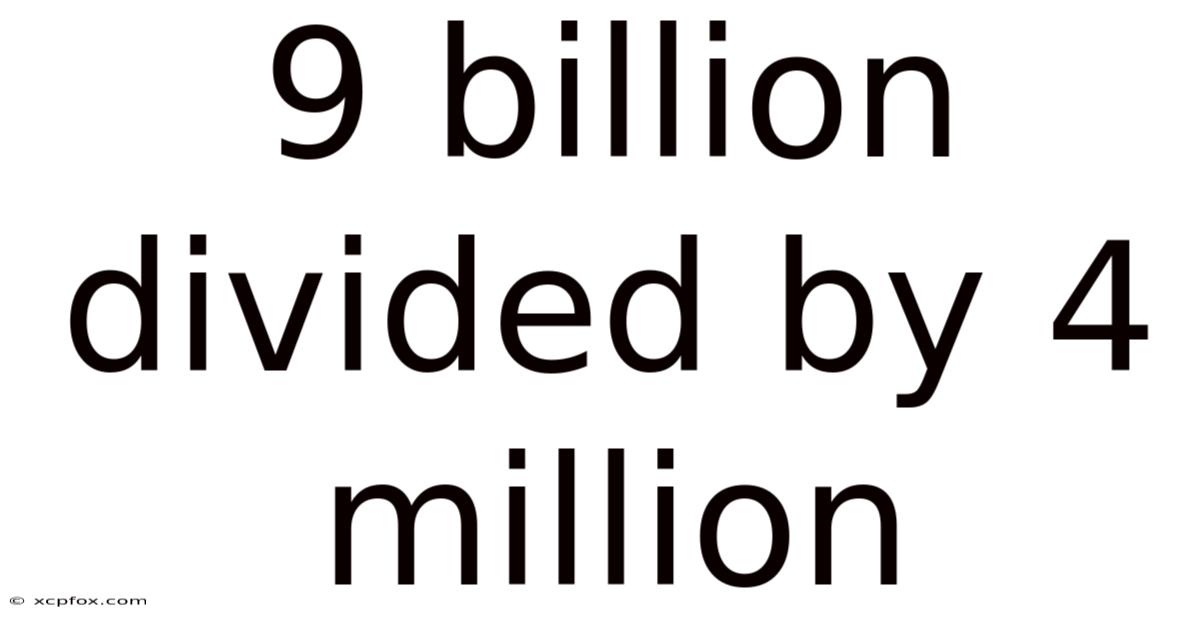
Imagine you're organizing a massive event, a global initiative perhaps. You have a budget of $9 billion and need to distribute it among 4 million participants. How much does each person get? That said, that's essentially what the calculation "9 billion divided by 4 million" represents. Now, it's a fundamental arithmetic problem with real-world applications across finance, statistics, and resource allocation. Understanding the math is one thing, but grasping the implications and practical uses elevates this calculation from a simple exercise to a valuable analytical tool.
The answer, of course, is 2,250. But what does that number really mean? Practically speaking, in the context of our opening scenario, it means each participant receives $2,250. Even so, the significance goes far beyond this single example. From understanding population densities to calculating per capita income, the principle of dividing a large number by another large number is a cornerstone of understanding the world around us. This article will look at the math, the applications, and the nuances of this calculation, providing a comprehensive overview of its importance and relevance.
It sounds simple, but the gap is usually here.
Understanding the Basics
At its core, 9,000,000,000 divided by 4,000,000 is a division problem. Practically speaking, in this case, we are splitting nine billion into four million equal parts. Which means division, one of the four basic arithmetic operations (along with addition, subtraction, and multiplication), involves splitting a quantity into equal parts. The number being divided (9,000,000,000) is called the dividend, the number we are dividing by (4,000,000) is the divisor, and the result (2,250) is the quotient.
No fluff here — just what actually works Easy to understand, harder to ignore..
The mathematical notation for this operation is: 9,000,000,000 ÷ 4,000,000 = 2,250. This can also be expressed as a fraction: 9,000,000,000/4,000,000, which simplifies to 2,250. Day to day, understanding this basic structure is crucial before exploring the more complex applications of this calculation. This simple division problem unveils a powerful tool applicable to a wide range of scenarios, from resource allocation to statistical analysis.
Let's break down the division process. So since both numbers have six zeros, we can effectively divide both by 1,000,000, resulting in 9,000 divided by 4. You can simplify the calculation by canceling out the common zeros in both the dividend and the divisor. This simplified problem is much easier to manage It's one of those things that adds up..
Now, we perform the division. 4 goes into 9 twice (2 x 4 = 8), leaving a remainder of 1. Still, we bring down the next zero, making it 10. Day to day, 4 goes into 10 twice (2 x 4 = 8), leaving a remainder of 2. We bring down the next zero, making it 20. Because of that, 4 goes into 20 five times (5 x 4 = 20), leaving no remainder. Here's the thing — finally, we bring down the last zero, and since 4 goes into 0 zero times, we add a zero to the end. So, 9,000 divided by 4 equals 2,250.
This stepwise approach demystifies the calculation and highlights the importance of understanding basic arithmetic principles. The ability to simplify complex problems into manageable steps is a valuable skill in mathematics and beyond. This foundational understanding allows for tackling more sophisticated calculations and appreciating their real-world implications.
The concept of significant figures also plays a role in understanding the precision of this calculation. This leads to while 9,000,000,000 and 4,000,000 appear as exact numbers, in real-world applications they might represent estimates or approximations. Still, if the initial figures are only accurate to a certain number of significant figures, the final result should be rounded accordingly to reflect that uncertainty. As an example, if 9 billion was actually 9.0 billion (two significant figures) and 4 million was actually 4.0 million (two significant figures), then the result, 2,250, should be rounded to two significant figures, resulting in 2,300.
Understanding the limitations of the input data is crucial for interpreting the results accurately. The awareness of these nuances is critical in professional settings where data analysis informs decision-making. Ignoring significant figures can lead to a false sense of precision and potentially flawed conclusions. This awareness of the subtle details underscores the importance of critical thinking and data literacy The details matter here..
What's more, the concept of ratios and proportions is closely related to this division problem. That said, the result, 2,250, represents the ratio between the dividend and the divisor. Put another way, for every one unit of the divisor (4,000,000), there are 2,250 units of the quotient. This relationship can be expressed as a proportion: 9,000,000,000 is to 4,000,000 as 2,250 is to 1 Practical, not theoretical..
Understanding ratios and proportions allows us to scale the result and apply it to different scenarios. This proportional reasoning is a powerful tool for solving problems and making comparisons in various contexts. To give you an idea, if we wanted to find out what the result would be if we doubled the divisor, we could simply divide the quotient by 2. The ability to manipulate these relationships demonstrates a deeper understanding of mathematical principles and their practical applications.
Trends and Latest Developments
In recent years, the ability to perform and interpret calculations involving large numbers has become increasingly important due to the exponential growth of data in various fields. Day to day, the rise of big data in areas such as finance, healthcare, and social media has created a demand for professionals who can analyze and extract meaningful insights from vast datasets. The calculation of 9 billion divided by 4 million, though seemingly simple, represents a fundamental building block for more complex data analysis techniques.
To give you an idea, in the financial sector, analysts use similar calculations to assess the performance of investment portfolios, calculate risk-adjusted returns, and evaluate the efficiency of different trading strategies. In healthcare, researchers may use such divisions to determine the prevalence of a disease in a population or to calculate the cost-effectiveness of a new treatment. The underlying mathematical principles remain the same, even though the context and the scale of the numbers may vary significantly Still holds up..
One notable trend is the increasing reliance on automation and software tools for performing these calculations. Still, it is crucial to remember that these tools are only as good as the user's understanding of the underlying principles. Spreadsheets, statistical software packages, and programming languages like Python and R provide powerful capabilities for handling large datasets and performing complex mathematical operations. A solid grasp of basic arithmetic and statistical concepts is essential for interpreting the results correctly and avoiding errors That's the part that actually makes a difference. Simple as that..
Another development is the growing emphasis on data visualization. Presenting data in a clear and concise manner is crucial for communicating insights effectively to a broader audience. Charts, graphs, and interactive dashboards can help to illustrate the relationships between variables and highlight key findings. The ability to transform raw data into meaningful visualizations is a valuable skill in today's data-driven world.
What's more, the ethical considerations surrounding data analysis are becoming increasingly important. As data becomes more readily available, it is crucial to be mindful of privacy concerns and to make sure data is used responsibly and ethically. Still, bias in data can lead to unfair or discriminatory outcomes, so You really need to be aware of potential sources of bias and to take steps to mitigate them. The responsible use of data is a critical aspect of data analysis and requires a strong ethical framework.
The use of cloud computing has also revolutionized the way large-scale calculations are performed. Which means cloud platforms provide access to vast amounts of computing power and storage capacity, enabling researchers and analysts to process and analyze data that would have been impossible to handle just a few years ago. This has opened up new possibilities for data analysis and has accelerated the pace of discovery in many fields Simple, but easy to overlook..
Tips and Expert Advice
When performing calculations involving large numbers like 9 billion divided by 4 million, accuracy and efficiency are essential. Here are some tips and expert advice to ensure you get the correct answer and can apply it effectively:
First, **double-check your input data.It's a good practice to use reliable sources and cross-reference your data whenever possible. In real terms, ** A small error in the numbers can lead to a significant difference in the result. This is especially important when dealing with financial data or scientific measurements where precision is critical. Because of that, verify the source of your data and confirm that you have entered the correct values into your calculator or spreadsheet. Remember the principle of "garbage in, garbage out"; even the most sophisticated analysis tools cannot compensate for flawed input data Most people skip this — try not to..
Second, use a calculator or spreadsheet software. While it is possible to perform the calculation manually, it is much more efficient and less prone to error to use a calculator or spreadsheet program like Microsoft Excel or Google Sheets. These tools are designed to handle large numbers and complex calculations with ease. In practice, familiarize yourself with the basic functions of these tools and learn how to use formulas to automate your calculations. This will save you time and reduce the risk of making mistakes. Beyond that, spreadsheet software allows you to easily modify your data and recalculate the results, making it ideal for sensitivity analysis and what-if scenarios.
Third, **simplify the problem when possible.That's why look for opportunities to simplify the problem by factoring out common terms or using algebraic identities. ** As mentioned earlier, simplifying the calculation by canceling out common zeros can make it easier to manage. That said, this technique can be applied to other types of calculations as well. This will not only make the calculation easier but also help you to understand the underlying relationships between the variables. Simplifying complex problems into manageable steps is a valuable skill that can be applied in many different areas of life That's the part that actually makes a difference..
Fourth, **be mindful of units.Still, ** Don't overlook when working with real-world data, it. Worth adding: it carries more weight than people think. Even so, for example, if you are calculating the density of a substance, you need to make sure that the mass and volume are expressed in compatible units, such as kilograms per cubic meter or grams per cubic centimeter. But make sure that you are using consistent units throughout your calculation and that you are converting units correctly when necessary. Neglecting to pay attention to units can lead to significant errors and incorrect conclusions.
Fifth, **round your answer appropriately.Rounding your answer to too many decimal places can give a false sense of precision. Conversely, rounding too aggressively can obscure important details. Practically speaking, ** The number of significant figures in your answer should reflect the precision of your input data. If your input data is only accurate to two significant figures, then your answer should also be rounded to two significant figures. Use your judgment and consider the context of the problem when deciding how to round your answer.
Sixth, **interpret your result in context.So ** The result of a calculation is only meaningful if it is interpreted in the context of the problem. Even so, consider the implications of your result and how it relates to the real world. Ask yourself whether the result makes sense and whether it is consistent with other information that you know. Think about it: if the result seems surprising or unexpected, investigate further to see if you can identify any errors or inconsistencies. The ability to interpret results in context is a critical skill for data analysis and decision-making Most people skip this — try not to..
Seventh, visualize your data. Creating charts and graphs can help you to understand the relationships between variables and to identify patterns that might not be apparent from looking at raw numbers. Use visualization tools to explore your data and to communicate your findings to others. There are many different types of charts and graphs to choose from, so select the ones that are most appropriate for your data and your message. Visualizations can be a powerful tool for gaining insights and for communicating complex information in a clear and concise manner.
Finally, **seek expert advice when needed.There are many resources available online and in your community to help you with your data analysis needs. In practice, ** If you are unsure about any aspect of the calculation or the interpretation of the results, don't hesitate to seek advice from a qualified expert. A statistician, mathematician, or financial analyst can provide valuable insights and help you to avoid costly errors. Don't be afraid to ask for help when you need it.
FAQ
Q: What is the result of 9 billion divided by 4 million? A: The result is 2,250 The details matter here..
Q: How can I simplify the calculation of 9,000,000,000 / 4,000,000? A: You can simplify by canceling out the six zeros common to both numbers, reducing the problem to 9,000 / 4.
Q: In what scenarios is this calculation useful? A: This type of calculation is useful in many scenarios, including resource allocation, calculating per capita income, determining population densities, and analyzing financial data And that's really what it comes down to..
Q: What tools can I use to perform this calculation accurately? A: Calculators and spreadsheet software like Microsoft Excel or Google Sheets are recommended for accuracy and efficiency Simple, but easy to overlook. Worth knowing..
Q: Why is it important to consider significant figures in this calculation? A: Considering significant figures ensures that the precision of the result reflects the precision of the original numbers, preventing a false sense of accuracy.
Q: How do ratios and proportions relate to this division problem? A: The result, 2,250, represents the ratio between the dividend and the divisor. This allows for scaling the result and applying it to different scenarios.
Q: What is the role of data visualization in analyzing this calculation? A: Data visualization helps in understanding the relationships between variables and communicating findings clearly through charts and graphs Not complicated — just consistent..
Q: What ethical considerations should be kept in mind when working with large numbers and data analysis? A: It's crucial to be mindful of privacy concerns, ensure data is used responsibly, and be aware of potential biases in data to avoid unfair outcomes.
Conclusion
The calculation of 9 billion divided by 4 million, resulting in 2,250, might seem like a simple arithmetic problem at first glance. Worth adding: this fundamental calculation serves as a building block for understanding resource allocation, financial analysis, statistical analysis, and a wide range of real-world scenarios. That said, its implications and applications are far-reaching. By understanding the underlying mathematical principles, being mindful of data precision, and using appropriate tools and techniques, you can effectively apply this calculation to solve complex problems and gain valuable insights.
Counterintuitive, but true The details matter here..
Understanding this division lays the groundwork for more advanced mathematical concepts and enhances critical thinking skills. Whether you're managing a budget, analyzing market data, or simply trying to understand the world around you, the ability to perform and interpret calculations involving large numbers is a valuable asset. Now that you have a solid understanding of the principles and applications of 9 billion divided by 4 million, take the next step and explore how you can apply this knowledge to your own personal and professional endeavors. Share this article with your colleagues and friends, and let's continue to explore the power of mathematics together Worth keeping that in mind. No workaround needed..
